Thursday, December 8, 2011

Miyazaki, Japan, and the mother of all meals


As the flight readies to land, the air hostess notices my lit ipod screen and fusses about it needing to be shut down.  I tell her that it does not have an on-off switch.  Having just finished Walter Isaacson’s biography of Steve Jobs on the plane, I want to tell her that Jobs deliberately did not install on-off switches on his ipods, that genius though he may be, he hadn’t prepared for the eventuality that I was faced with.  She looked pissed, I tried to explain, then mercifully the screen went to sleep, and she went about her way.

All of my trips to Japan so far have been in and around Tokyo.  This is the first time that I travel south, to the city of Miyazaki, on the southernmost island of Japan, just a couple of hours from Taipei.  The domestic flight from Tokyo flies in from the ocean on a crisp, clear night.  A single police car with a flashing red light stands at guard on a narrow access road against the edge of the water, the runway a stone’s throw from the ocean.  Miyazaki is calm, and cool—palm trees grace the dividers of large highways, the temperature is at 9 C. 

After a confusing sequence of conversations that resembles the characteristics of a diode, the taxi driver eventually takes me to my intended hotel.  I have seen this repeatedly with Japanese taxidrivers.  The key moment is the one when you disclose to him your intended location.  If he nods a curt “hai”, you will arrive at your hotel without drama.  If he repeats the hotel name and throws it back to you as a question, then you are in for a sightseeing tour.  And, given his legendary honesty, if he ends up taking you to the wrong place as an interim pit stop, then he will not charge you the extra amount incurred. 

Japanese hotels have the most high tech bathrooms that I have ever seen.  A low rumble from the hotel room toilet greets me.  There are various functions available to the seated adventurer, including a seat warmer and a couple of plumbing options that can turn it into a small waterpark for your rear end.  I am confident that in a couple of years these will come Ethernet ready.

I go for a pre-dawn jog—my jetlagged body responds well to the bracing air.  There are few cars and just a handful of joggers around.  I take a path by the river, bordered on one side by line of dim lights set on concrete posts.  The line of the river curves on the other side.  At the end of the path there is a small, circular concrete amphitheater with steps leading down to the river.  I stand there by the river and take a  break. The place is empty, except for the dim figure of another jogger running past.  It is a beautiful calm sight.

Dinner that night was a welcome,  formal multi-course meal at a traditional Japanese restaurant with pine woodwork and Japanese style furniture.  These dinners grind you in a game of crushing seduction, dinners that stretch into hours, course by course, where you-- discombobulated by alcohol, by jetlag, by the unfamiliarity of the language, by exotic flavors, give in willingly to the strange food goblins that toss you from lap to lap till you are spent.  The meal starts with a threesome of little appetizer sized bowls of angler fish liver, oyster and protein rich soy skin, followed by one of the most gorgeous soups that I have ever had: a smoky, light, clear broth with matsutake mushrooms, shitake mushrooms and pieces of chicken.  The dishes come, sequenced against one another, like the ebb and flow of a great river.  Sashimi arrives: tuna—probably from New York, bream and mackerel and a giant lobster sized shrimp.  My neighbour passes over the next dish-- mushroom with sperm of Cod.  I decide to go for it.  If I could have eggs, this could’nt hurt--what was good in the goose was certainly good in the gander.  Then, following some chunks of Miyazaki beef, a point of pride with the locals, we wrap up with seaweed, fish egg, shrimp, a salmon and soy gratin and fruits.  This, was the mother of all meals.


The hotel was a welcome walk away and as I exit into the night air and head to the street, my Japanese friend motions me to hold off for a bit.  There was a commotion about 25 meters ahead.  Three young women in tight, baby doll getups, flurried around a cab.   One frisked up to in the restaurant in impossible heels and after a brief conversation with the staff, returned.  A slim man in his late fifties in a suit emerged from the taxi, seemingly agitated.  And then after some more consultation, the women and man got into another taxi and drove off.  This was the Yakuza, I was told, and while they usually did not bother the common man, it was best to avoid them.

The next day we drive into the countryside.  Japanese countryside looks like Assamese countryside that has been Europeanized. We drove on a narrow road raised on an embankment, either side of which were small marked and bordered fields for cultivation, some of them paddy.  Grass and shrubs grew at the edges of concrete footpaths that were stain darkened by the humidity.  Neat houses with sloping roofs lay adjacent to the fields, connected by narrow lanes.  There were hills in the background, bamboo outgrowths by the road.  This could be Assam, this was a very Asian landscape, except that the houses had the ship shape fittings of Swiss dwellings, there were solar panels on the roofs, late model cars were parked by the farmers houses, and a bicyclist wearing a Bissell outfit hunched over a road bike cornered a bend in the road.  And there were no temples.

On the way back at Narita Airport in Tokyo, I look in vain for a store that would sell Japanese ceramics and traditional pottery, things like that.  The entire place is filled with booze and perfume shops, kitschy Japanese objects and overpriced Western designer stores filled with stuff that looks crass against the muted delicacy of Japanese design.  I give up and retreat to the Kookai Noodle Shop for a bowl of Ramen.  Always guaranteed to uplift a tired traveler.  But more on than later.

Sunday, November 27, 2011

How does a chapati or roti fluff up?


Many of us are familiar with the way to make a perfect chapati or roti:  (i) roll flat a piece of moist dough evenly, (ii) heat one side on a pan, (iii) flip and heat the other side, (iv) then put it directly onto the flames.  If done right, the chapati puffs up like a balloon, a giant bubble of water vapor contained within the intact surface of the roti.  Why and how does this happen? Centuries of chapati making have led, through trial and error, to this sequence of steps. Think through this, as we did through a dinner conversation with my younger son, and there are clear scientific reasons behind each of these steps.

When a chapati is heated, dissolved water in the dough evaporates and collects together to form small bubbles which then coalesce into one large bubble. As more dissolved moisture is converted to vapor, the bubble grows, pumping up the chapati and pushing the malleable dough outward.  Instead of growing large as it does, why doesn't the water vapor bubble simply escape by perforating the front or the back surface, as in the figure below?  These surfaces are readily available to the bubble less than a millimeter away!

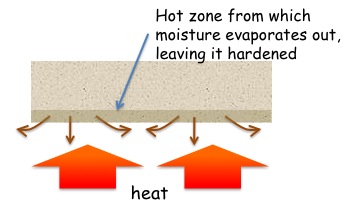
The answer lies in the manner that the chapati is heated.  Take the hottest part of the chapati—the bottom surface that is in contact with the hot pan.   Water vapor that has formed within an escape depth of this surface leaks out through the back.  This water denuded outer layer of dough now hardens, losing its malleability and making it harder for a  water vapor bubble to punch through.
 
Now the top surface needs hardening as well—which is why in the best puffed chapatis you need to heat one side, then flip over to heat the other side.  Once both surfaces have been hardened, the escape routes from top and bottom have been sealed, the growing bubble is frustrated and forced to expand laterally, as in the figure below.

Why is there a single bubble and not many?  When a bubble is formed, a new surface is created (i.e. the circumference of the bubble).  This has an energy cost because atomic bonds have to be broken to create the surface (if you split a wooden log in two, you have expended energy to break atomic bonds to create two new surfaces that weren’t there).  Systems in nature always try to minimize the energy cost if they can. If two bubbles of the same radius coalesce to form a single bubble, the surface area reduces to 2-1/3 of the original area, if n bubbles coalesce, the area reduction is a factor of n-1/3.  Creating a single large bubble instead of many small ones therefore requires a smaller area of surface to be created, and a lower energy cost.  It is thus fated that the bubbles must give up their individuality.  This is why in a good chapatti, in the end, there is one huge bubble. 

We are still left with step (iv), that the best chapattis are made when—after heating each side on a pan--the chapatti is put directly onto the flames for a vigorous fluff up.  There is a reason behind this as well. The dough is not perfect.  Some water vapor can still leak out through the top and bottom surfaces.  There is therefore a small “leak rate”.  Now when the dissolved moisture is converted to vapor in a hot chapatti, there is a certain gas generation rate. If this generation rate is much larger than the leak rate, then we can expect a good puff, otherwise not. Sticking the chapatti directly onto the flames raises its temperature and rapidly converts the moisture into gas—greatly increasing the gas generation rate and making the leak rate negligible in comparison.


Thursday, November 17, 2011

Indian food, the Ngram viewer, and some statistics


I heard an interesting talk recently by Jean-Baptiste Michel from Harvard’s Cultural Observation Laboratory, on tracking the appearance of specific words in print since the early 1800s.  Their database was the vast collection of digitized books, that now cover about 4% of all printed books in English.  The results offer a window into cultural trends through the ages, and has the potential to become a useful quantitative tool in the hands of social scientists.  This tool is available on the web (http://books.google.com/ngrams) and for some amusement, given that this is an Indian food blog, lets take a quick look at how Indian food has been received in the West through the years.
Blue: tandoori; red: vindaloo; yellow: raita, green: mulligatawny

Take a look at the graph above.  The Y axis shows the frequency (as a function of percentage of all printed words) with which the words tandoori, vindaloo and raita appear in all English books printed since 1800 that are available via Google Books.  I picked these words as being representative of Indian dishes popular in the West.  They make their appearance in print around the 1960s, coincident with the wave of sub-continental immigration into the UK.  The curves rise rapidly, reflecting the popularity of Indian food the past 15 years.  Compare them against the granddaddy of Anglo-Indian cuisine—the Mulligatawny Soup.  Nobody has Mulligatawny soup these days, we never had it growing up in India, and it is largely unavailable except in some Indian restaurants in the US (and perhaps England) who strain to create a “Raj” ambience.  But at one time in the 1800s, Mulligatawny was king of the hill, and one of the first culinary products that came out of the British –Indian encounter.  Consider this advise given to a young man considering a commission with the East India company in “The Surgeon’s Daughter” (1800) by Sir Walter Scott,
 “'If you, my dear fellow,' continued he, extending his hand to Middlemas, 'would think of changing sheep-head broth and haggis for mulligatawny and curry, I can only say that, though it is indispensable that you should enter the serv-ice at first simply as a cadet, yet, by , you should live like a brother on the passage with me; and no soonef were we through the surf at Madras than I would put you in the way of acquiring both wealth and glory…
And, Walter Scott was not the only one--the graph shows a steady representation for Mulligatawny since the 1820s that has continued to this day.

How popular is Indian food compared with Chinese?  The figure below shows the frequency of Chow Mein, Chop Suey, and Lo Mein over time. Chinese food of course became popular at an earlier time compared to Indian--this is supported by the graphs; what is also interesting is the relative use of the words themselves. Chop Suey is an older term, was at the height of its popularity in the early 1940s for reasons that are unclear (perhaps related to WWII?). Its usage has dwindled, though it is still popular today, at about the same level as Chow MeinLo Mein camd later, around at the time that Indian food started becoming popular.  I would have thought that Chinese fare is still ahead, but we find that the popularity of tandoori and Chow Mein--at least in print-- are now about the same.
 

Blue: chow mein, red: chop suey; green: lo mein

And, digressing a bit from food, what about Indian stereotypes?  Even into the 70s and 80s, the “Indian snake charmer” kept alive the colonial concept of the mysterious East; it was even pandered to—I recall Mad Magazine from the 70s with a spread from the well known Indian cartoonist, Sudhir Dar, which had an entry that played on this same theme.  This embodiment, as we all know, gave way to the Indian programmer in the 2000s—even making their way into TV commercials the past few years.  So how do they look on Ngram? Surprisingly, the Indian snake charmer is still around, after enjoying some peak attention between 1900 and 1920 for reasons unknown.  The Indian programmer has climbed steeply since 1990, though unexpectedly, still neck and neck with the snake charmer .
Blue: Indian programmer; red: Indian snake charmer


Monday, October 24, 2011

Neerob, on Starling Avenue in the Bronx


www.neerob.com/

Neerob is a Bangladeshi restaurant that is part of a block’s worth of Bengali shops in the Bronx, known as “Banglabazaar”.  In the evening the small restaurant is crowded with young Bangladeshi men sitting around tables, in the middle of an “adda”(a rump session), with cups of tea.  Neerob does a brisk take out business with an established clientele, and the occasional newcomer attracted by the recent review of Neerob that appeared in the New York Times.

Most Bengali restaurants in the tri-state area are Bangladeshi, and as far as I know the now shuttered “Babu” in Greenwich Village was the only restaurant from the Indian side of Bengal, i.e. the state of W. Bengal.  This is not a bad thing as the East Bengalis (i.e. folks from Bangladesh) have a fabulous cooking legacy and they will sneer at the prissy cooking habits of the West Bengalis, their lack of spontaneity, and their annoying habit of adding a spoon of sugar into anything that they cook.  Mass migration of hindus from eastern to western Bengal took place during India’s independence in 1947.  The nation partitioned along religious lines into India and Pakistan, and the food and culture of West Bengal changed forever. 

The Bengali food from Bangladesh differs in two respects from Indian Bengali food.  The first is the heavy muslim influence: the use of beef and aromatic spices more common to North Indian cooking.  Try the Beef Tehari, for instance, something that you will not find in an Indian restaurant.  The second difference, characteristic to many Bangladeshi restaurants, is the heavy handed use of chilli powder and spices, making the food discomfortingly “hot”.  Unless you are at the “macho man” stage of South Asian food appreciation, this will not be too exciting.

The biryanis at Neerob are fragrant and have chunks of tender meat in generous amounts--I would go back again, for the biryani alone.  The hilsa fish curry comes packed in oil, like chunks of sodium that explode in your mouth with heat.  Hilsa is a delicate fish that sings to you when lightly cooked , with a streak of mustard across its tender meat that is held together by a gossamer scaffold of a thousand bones.  It is a travesty to cook it with so much oil and chili.   The goat curry was surprisingly mild and, like the biryani, had soft, quality cuts of meat.  In the confections department, the rosogullas were a delight, with restrained use of sugar.  But the gulab jamuns, which taste fine, show hints of artificial coloring: their whitish cores were tinged with crimson.  There is no need to add coloring—this is a thing of the past and if Neerab is to get the attention of an increasing variety of clientele, they need to pay attention to things such as these.

But go there for the biryanis, for the tea that they will pour out in paper cups at a dollar a cup, and for the ambiance of the adda that grabs the place every evening—for that alone, it is worth a trip to Neerob.
Neerob on Urbanspoon

Saturday, October 15, 2011

Obergurgl, Zurich, and the Dark Prince of Burkliplatz


Rail transportation has a distant civility about it in Western Europe, a quietness with which a train arrives precisely on time, the methodical motions of the embarking and disembarking passengers like two insoluble streams of fluid, and a hushed whisper with which the train plunges through wonderfully engineered pathways.  Heading out of Zurich I had changed trains at a small station in Austria, Landeck-Zams, en-route to Obergurgl, a small town high in the Austrian alps.  The lady at the Zurich airport train station had, with unwavering politeness,  outlined for me departures, arrivals and changeovers precise to the minute under whitish fluorescent illumination that seemed to bathe the place in a cloak of efficiency.  So I was now in Landeck-Zams, waiting for it to leave, at exactly  the time that she had said I would—in a few days I would be disembarking at stations looking at my watch rather than the station’s name on the platform.

My train compartment is largely empty except for a gaggle of ten year olds on their way back from school.  They travel by themselves on the train, running around, pummeling each other playfully.  When the train stops at a small village with a cute brightly colored micro car parked by the station road (these autos seem to be the mascots for small railway stations, just like the rickshaw stands by the railways in the outer towns of Kolkata), a couple of kids hop off (there is no platform), jump over the tracks and head on home.  My train creaks as it climbs up the Alps, past angry mountain brooks fed by waterfalls and man made networks of gutters, coniferous forests, sheer walls of rock, past little villages with tidy houses, farms, pickup trucks and bales of hay sealed in plastic sheaths.  I get off at a little station called Otztal and then am driven up a winding mountain road with snow on the ground, through hairpin turns and dollhouse villages, taverns with signs for “Table Dancing” (a sign of the large tourist trade during skiing season), the roads wet with constant rain.  49 kilometers later I am dropped off with my bags at a tiny village, Obergurgl, one of the highest towns in Austria at 2000 m with moutains all around me, and a conference center run by the University of Innsbruck where I will stay for a few days. 

I am here for a conference and taking advantage of a break one afternoon I head for a hike following a small road that heads towards the mountains.  A while later it changes to a dirt road, and then to a hiking trail.  I feel awkard in dress slacks that I have tucked into my socks  to avoid the snow, as I am passed by a purposeful hiker with walking sticks, his long, leathery, alpine-sun tanned frame gliding past me like a vigorous dancer.  This is a ski paradise--the white mountains are criss-crossed by ski lifts and the dormant hotels come alive starting November as the tourists arrive in droves, but for now I have the place more or less to myself.  The resident population is in the few hundreds, but it winter swells to close to a hundred thousand.
Most of the locals are long time residents.  The older gentleman who drove me out to Obergurgl has been in the Otztal valley since birth and runs the local car service outside the train station with his wife.  He had been to New York once, as part of a firefighters delegation a decade ago, and described his memory of the city as one with a narrow view of the sky above, with his peripheral vision blocked by walls of concrete. New York City always brings about a wistful look in the eyes of those who have visited it only once and they will recount the city often with a single defining experience. As he spoke of NYC, this gentleman had the same look, the same symbolic wave of the hand, that I had seen in the Minneapolis cabbie years ago who, upon learning I was headed to NYC, declared that his one visit there with his girlfriend years ago gave him “the best sex that he ever had”. The city stands as a singularity in their imaginations, these two cabbies, one passing slower trucks with deft maneuvers in his Mercedes on an alpine mountain road, the other in a boatlike town car surging through the St. Paul suburbs in a cabin full of crimson upholstery.

A few days later I return back to Zurich and one evening I meet up with my old high school buddy S, a long time resident of Switzerland.  She takes me for ice cream to Movenpick, a chain store about 5 mins from the Burkliplatz neighborhood.  Listening to us speak in Bengali, the counter attendant responds in in the same language.  Originally from Bangladesh, he has married locally and settled down in Switzerland.  Overhearing us, a customer seated in the restaurant folds his hands and addresses us with a  Nomoshkar kemon  aachen (hello how are you).  It is nine o’clock at night, downtown  Zurich--as is normally the case--has started thinning, and here are 4 Bengalis in a Movenpick by the lake.  The customer is a dapper young man in a black suit and a goatee and we end up sitting at the table next to his.  Debonair and engaging, he has worked in Zurich for the past 4 years after graduating as an engineer from Jadavpur.  Koto din Aachen ekhaaney (how long have you been here) asks S in polite conversation.  Ami apnar cheye onek choto, amakey tumi bolben (I am much younger than you, please address me with “tumi”— which is a form of address directed for people younger than you).  I can see that S, who looks younger than her years, is not amused. The man’s Swiss girlfriend arrives soon after and following introductions, they drop off into deep and at times anguished conversation.  We pick up snatches-- there is a misunderstanding, he had not expected her to get as emotionally involved as she had.  This does not help his stock in S’s eyes--the young lady is probably around our children's age.  After a while, preparing to leave, he bids us farewell.  “Dekha hobey kokhono” (see you later) says S in parting formality, her lips pursed.  With a gaze that Rajesh Khanna reserved for his heroines he looks her in the eye “Nishchoi hobey.  Sundar mookh ami kokhono bhuli na” (we will certainly meet—I never forget a beautiful face).  And with that, the dark prince of Burkliplatz glides off into the darkness with his flame. S remains unimpressed, though deep inside, I suspect that the flattery has made some amends.