Saturday, February 18, 2012

Musical Band Box on All India Radio


Glen Campbell’s felicitation at the recent Grammy awards brought memories of Musical Band Box, the All India Radio program out of Calcutta in the 1970s and 80s.  A niche program that catered to the city’s Anglo-Indian residents and a handful of “western” music aficionados (everything from rock to pop to jazz was lumped into this category), it ran on a lazy Sunday afternoon at 1 pm sharp, when the city stooped to rest after lunch while the trams creaked under the blazing sun.  That one hour—the only time on All India Radio that you could hear rock or pop—was dedicated to the romantics: Glen Campbell, Neil Diamond, Merle Haggard, Karen Carpenter, and the Anglo Indian community’s prodigal sons—Cliff Richard and Engelbert Humperdinck who had made their way out of Lucknow and Madras.  The songs were in response to listener requests—birthday, christmas, marriage wishes to relatives and friends in Lucknow, Australia, Britain and America. 

Layered inbetween these crooners, would be bands like Abba and Bread, but generally nothing stronger (with the exception of an occasional Rolling Stones).   About the most potent they would get was when Cliff Richard came out with Devil Woman with its driving guitar backing.  Seldom Clapton, never Chuck Berry, never Freddie Mercury though he too, was in some ways a prodigal son, seldom Santana whose Black Magic Woman/ Oye Como Va single I had to dig out from a second hand store on Free School Street.  There were steady instrumental favorites—the Ventures, and to a lesser extent, Cliff Richard’s backing band, The Shadows

The Beatles over-rode any genre bias that this program had and were featured prominently, but there were also funk bands that were enormously popular that had little bearing in the West—the British-African Osibisa and their hit number Woyaya, cemented their stature in India with a concert tour in the 80s; Mandrill, another obscure band with “Beast from the East”. Boney M was the rage for a while-- their 33 & 1/3 albums with racy cover photos graced the displays of music stores such as Melody on Rashbehari, and Bambino in Gariahat.  Then, when Saturday Night Fever hit (American influence throbbed in like piston bursts with movies such as Rocky and SNF), the Bees Gees burst out of the gates.

All India Radio’s Band Box was part of a small but intense community of “Western” music fans, that was supported at that time by a now defunct magazine called Junior Statesman, that in hindsight was way ahead of its times. With the exception of bands such as the remarkable mid-seventies era Mohiner Ghoraguli who sang in Bengali and were anchored by the talented Goutam Mukhopadhyay (for one of his rare live performances see http://www.youtube.com/watch?v=bWrGrMKaE2c), most of these bands were cover bands, faithful in their mimicry down to the last note on the riffs. It would be years until Indian bands played their own music, beginning with Indus Creed in the mid 90s (who had their own lyrics, but on imitative arrangements) to Avial or Mother Jane today. Other than small pockets in the North East such as Shillong, it was, and still is an acquired music in the rest of India, and it shows.  Even today, there are county level musicians in New York who have better technique than most of the best Indian guitarists.  It is the same rationale by which George Harrison, while a great guitarist, never turned out to be a first rate sitar player--to the extent that many doubted that he could have played the sitar lines in Norwegian Wood.

Friday, January 20, 2012

Trip to Mumbai, Mangalorean food and the Mahesh Lunch Home in Sakinaka, Jan 2012


The accumulation of must have electronics piles up in preparation for a trip.  By the time I have packed a laptop, an ipod, headphones, a small camera, a Kindle, various power supplies, plugs and cords, the backpack feels quite full.   It is January, there is a light flurry on the drive down the New Jersey Turnpike, and the overcast sky renders the industrial buildings a gloomy monochrome.

I drive with the usual slight apprehension prior to a trip to India.  The sentiments have transposed somewhat in the 25 years that I have been here.  Almost 40 years ago I had heard my first descriptions of America as a child from an aunt and uncle who had visited a relative in Ohio.  We sat around after dinner, wrapped under thick blankets in a bone chilling Assam cold, as the uncle, with a facility for storytelling, recounted their two month trip to the United States in vivid detail: the traffic jams, the tunnel underneath the ocean (Fort McHenry Tunnel?), the recounting of ordinary suburban life in Dayton, augmented by photographs of fresh faced smiling kids in bright jackets posing against wintry landscapes.  Sitting in a remote part of north east India, in a small town the description felt difficult to relate to.  The place felt exotic then but does not anymore.  On the other hand India has changed in many ways since, and I do not feel sure-footed there any more as I used to.

The Air India flight to Mumbai has a viewable list of Bengali movies on the  in-flight video.  Attempting to watch Jamai Raja starring one Ms. Paoli Dam, I learn one thing-- commercial Bengali films make Bollywood movies appear to have the sensitivity of Iranian films.  It is a color film full of black and white emotions, and I cannot take it after a couple of minutes. I spend the rest of the flight reading.

 Checkout at Mumbai is efficient—at times it is faster today to get out of Indian airports than the ones at New York or Narita.  Computerization coupled with a low cost of labor that allows many immigration officials to be deployed enables this.  For those of us used to the long delays at customs and immigration in the nineties this is a pleasant surprise. In those days I would often get to exchange pleasantries with the immigration official who would appear to be in no particular hurry; and the entry into the country often took upon the flavor of an extended social visit to the immigration hall.  Even after computers were introduced in the early days, the staff would often pick at the keyboards in single finger slow motion, the machine often a source for further confusion and delays. All this is streamlined now, and as in NY or Narita, there is an official who curtly directs traffic to the numerous immigration stalls, the transactions are business like, so that I am out in a matter of minutes.  But underlying this orderliness that is on display most of the time, there is always a looming threat of chaos in a system that appears to have no plan B or preparedness for handling anything out of the ordinary.  In a few days I would be held in a long delay at a domestic flight security line as a bevy of security officers examined a complicated medical instrument with a long optical fiber that a traveler had passed through the x-ray machine, holding up the everyone else, instead of taking the inspection off line so that others could proceed.

There is massive construction as a new terminal gets built, raising a dust that tinges the sky orange against the setting sun.  Mumbai is the most businesslike of Indian cities and inspite of an enormous population pressure, there is an efficient manner with which things self assemble in order for day-to-day life to proceed.  In one passing scene on a busy road a cricket game is in swing using the street as a pitch, pedestrians cross hopping between cars and two-wheelers, business is being conducted on the roadside stalls that have encroached onto the blacktop—yet these events glide past one another making subtle accommodation like a jigsaw puzzle in time, the people neither friendly nor discourteous to one another, avoiding redundant exchanges like two efficient boxers conserving their energies for the full distance.  As we proceed along the road to a friend’s house, we arrive at a jam ahead—there is a car burning and a large crowd gathered around it.  All the drivers calmly turnaround their vehicles, make room for one another within what space is available and we are soon re-reouted and on our way.  I doubt that Kolkata drivers would demonstrate this level of collective intelligence.  I spend the night with our friends S&P, where a wonderful evening of conversation and a hot Mangalorean and muslim meal awaits me. 


The next morning I am driven to IIT Bombay by the driver.  He points out that this was Bombay’s worst winter, and then proceeds to turn the airconditioning on in the car.  I had been sweating and I needed it.  The campus stands between a national park on one side, and a busy road on the other.  Parts of the campus are leafy, but it does not have the historical feel of IIT Kharagpur, or the natural beauty of IIT Guwahati.  Leopards come into campus every few years losing their way out of the national park.  In what is a humane process that other nations can learn from, these animals are invariably tranquilized and then released back into the wild.  Even when the animal has injured and killed people, as was the case with the recent appearance of a leopard in Guwahati, it is captured instead of destroyed. 

The IITs have changed significantly.  More emphasis is placed on research among the faculty and there is increased funding for labs and equipment.  A professor cannot expect promotion without demonstrating significant research content in his/her work and, in a departure from the past, the number of post-graduate students exceeds the numbers of undergraduates.  A majority of the undergraduates today arrive by way of intensive retreading at coaching factories that have gamed the entrance exam.  This has led to significant debate, and a possibility that the legendary entrance examination may be done away with.  With the exception of a few, graduating students prefer to take higher paying consulting type positions rather than traditional engineering jobs.  Far fewer travel to the United States for post-graduate education in engineering than used to earlier.

Afternoon presented an opportunity to visit a newly opened outpost of the Mahesh Lunch Home at Sakinaka.  Mahesh Lunch Home is a legendary Mangalorean fish place that, starting from its original establishment in Juhu, has spread across the city to four different locations. I had been to the one in Juhu several years ago, and it left a strong positive impression. It would make a fish lover evoke the same sentiments that the Mughal emperor Babar expressed upon visiting Kashmir—if there is a heaven then this is it, this is it, this is it.  It is one of the few Indian restaurants where I will eat fish, for fish molesters are a common lot among restaurant cooks.  Fish is not as forgiving as meat, and unlike meat strong spicing can subvert its flavor.  This is the reason why fish tastes best in Indian dishes that use fragrant, light spices—such as fish steamed with mustard, a light hint of coriander seeds, or fish simply fried with some turmeric and salt. The lunch that we had at Mahesh was all fish—and these were displayed to us, some alive, at the time of order.  We started with fried rolls stuffed with Bombay Duck (a type of fish) and prawns, and tawa (pan) fried pomfret. The pomfret, a Bombay specialty, was overloaded with tandoori type masala and an unexpected disappointment.  This was a pity since I get one shot at a perfect pomfret on these breakneck pace trips.  As the main entrée we had a superb crab curry in a butter garlic sauce accompanied by a Mangalorean specialty called a Neer dosa, a rice based dosa with a gelatinous, slick texture.  This is the very first time that I have scooped up crab (or any fish) using a piece of dosa, but this is one of the reasons to go to a place like Mahesh Lunch Home.

For all its ethnic sophistication, New York City is still mired either in traditional North Indian, South Indian, or the wallet scorching fusiony cusine that uppity Indians in Manhattan seem to enjoy.  On trips such as these, like the ancient British colonials on their annual trips to London from the sub-continental mofussils, I like to find what I cannot in Westchester county and NYC.  Fish at Mahesh Lunch Home is one of them.  Good Bengali food is another.

Wednesday, January 4, 2012

Neo Bistro, Mt. Kisco

www.neobistro.com
Neo is the only place in Westchester that I know of, that has begun serving Vietnamese Pho bowls.  It is a mixed Asian kind of place, that opened up a couple of years ago and seems to be doing good business.  I don't care much for the “dim and sleek” style décor, but the food will not disappoint you.  The bibimbap, served in a hot stone pot was well made, the rice well crusted against the side of the pot, a dish befitting the restaurant’s Korean management.  The Pho, with a broth richer and deeper than what is usual, was hearty and wholesome.  It appears currently as a special on the menu and I do hope that they do not drop it.  Lovers of Japanese noodle bowls such as Ramen, will like Pho for it offers the same mix of a casual,  satisfying and no-nonsense meal.  The sushi was of the same quality as any of the run-of-the-mill Northern Westchester sushi places.  The place does not have the cosiness of nearby Little Kabab Place, but has a varied collection of Asian dishes that are not phoney and well worth going for.
Note added Jan 29, 2012: A second visit ratified the conclusions from the first.  The Pho is a steady dish, with a wholesome, filling broth.  The bibimbop is reliable.  This place is a fusion Asian place that does not muck with the dishes by alloying them with different ethnic cuisines.  That often turns into a fashionable disaster.  It is fusion in the sense that they will serve dishes from different cuisines.  And they have made a success out of it.

Thursday, December 8, 2011

Miyazaki, Japan, and the mother of all meals


As the flight readies to land, the air hostess notices my lit ipod screen and fusses about it needing to be shut down.  I tell her that it does not have an on-off switch.  Having just finished Walter Isaacson’s biography of Steve Jobs on the plane, I want to tell her that Jobs deliberately did not install on-off switches on his ipods, that genius though he may be, he hadn’t prepared for the eventuality that I was faced with.  She looked pissed, I tried to explain, then mercifully the screen went to sleep, and she went about her way.

All of my trips to Japan so far have been in and around Tokyo.  This is the first time that I travel south, to the city of Miyazaki, on the southernmost island of Japan, just a couple of hours from Taipei.  The domestic flight from Tokyo flies in from the ocean on a crisp, clear night.  A single police car with a flashing red light stands at guard on a narrow access road against the edge of the water, the runway a stone’s throw from the ocean.  Miyazaki is calm, and cool—palm trees grace the dividers of large highways, the temperature is at 9 C. 

After a confusing sequence of conversations that resembles the characteristics of a diode, the taxi driver eventually takes me to my intended hotel.  I have seen this repeatedly with Japanese taxidrivers.  The key moment is the one when you disclose to him your intended location.  If he nods a curt “hai”, you will arrive at your hotel without drama.  If he repeats the hotel name and throws it back to you as a question, then you are in for a sightseeing tour.  And, given his legendary honesty, if he ends up taking you to the wrong place as an interim pit stop, then he will not charge you the extra amount incurred. 

Japanese hotels have the most high tech bathrooms that I have ever seen.  A low rumble from the hotel room toilet greets me.  There are various functions available to the seated adventurer, including a seat warmer and a couple of plumbing options that can turn it into a small waterpark for your rear end.  I am confident that in a couple of years these will come Ethernet ready.

I go for a pre-dawn jog—my jetlagged body responds well to the bracing air.  There are few cars and just a handful of joggers around.  I take a path by the river, bordered on one side by line of dim lights set on concrete posts.  The line of the river curves on the other side.  At the end of the path there is a small, circular concrete amphitheater with steps leading down to the river.  I stand there by the river and take a  break. The place is empty, except for the dim figure of another jogger running past.  It is a beautiful calm sight.

Dinner that night was a welcome,  formal multi-course meal at a traditional Japanese restaurant with pine woodwork and Japanese style furniture.  These dinners grind you in a game of crushing seduction, dinners that stretch into hours, course by course, where you-- discombobulated by alcohol, by jetlag, by the unfamiliarity of the language, by exotic flavors, give in willingly to the strange food goblins that toss you from lap to lap till you are spent.  The meal starts with a threesome of little appetizer sized bowls of angler fish liver, oyster and protein rich soy skin, followed by one of the most gorgeous soups that I have ever had: a smoky, light, clear broth with matsutake mushrooms, shitake mushrooms and pieces of chicken.  The dishes come, sequenced against one another, like the ebb and flow of a great river.  Sashimi arrives: tuna—probably from New York, bream and mackerel and a giant lobster sized shrimp.  My neighbour passes over the next dish-- mushroom with sperm of Cod.  I decide to go for it.  If I could have eggs, this could’nt hurt--what was good in the goose was certainly good in the gander.  Then, following some chunks of Miyazaki beef, a point of pride with the locals, we wrap up with seaweed, fish egg, shrimp, a salmon and soy gratin and fruits.  This, was the mother of all meals.


The hotel was a welcome walk away and as I exit into the night air and head to the street, my Japanese friend motions me to hold off for a bit.  There was a commotion about 25 meters ahead.  Three young women in tight, baby doll getups, flurried around a cab.   One frisked up to in the restaurant in impossible heels and after a brief conversation with the staff, returned.  A slim man in his late fifties in a suit emerged from the taxi, seemingly agitated.  And then after some more consultation, the women and man got into another taxi and drove off.  This was the Yakuza, I was told, and while they usually did not bother the common man, it was best to avoid them.

The next day we drive into the countryside.  Japanese countryside looks like Assamese countryside that has been Europeanized. We drove on a narrow road raised on an embankment, either side of which were small marked and bordered fields for cultivation, some of them paddy.  Grass and shrubs grew at the edges of concrete footpaths that were stain darkened by the humidity.  Neat houses with sloping roofs lay adjacent to the fields, connected by narrow lanes.  There were hills in the background, bamboo outgrowths by the road.  This could be Assam, this was a very Asian landscape, except that the houses had the ship shape fittings of Swiss dwellings, there were solar panels on the roofs, late model cars were parked by the farmers houses, and a bicyclist wearing a Bissell outfit hunched over a road bike cornered a bend in the road.  And there were no temples.

On the way back at Narita Airport in Tokyo, I look in vain for a store that would sell Japanese ceramics and traditional pottery, things like that.  The entire place is filled with booze and perfume shops, kitschy Japanese objects and overpriced Western designer stores filled with stuff that looks crass against the muted delicacy of Japanese design.  I give up and retreat to the Kookai Noodle Shop for a bowl of Ramen.  Always guaranteed to uplift a tired traveler.  But more on than later.

Sunday, November 27, 2011

How does a chapati or roti fluff up?


Many of us are familiar with the way to make a perfect chapati or roti:  (i) roll flat a piece of moist dough evenly, (ii) heat one side on a pan, (iii) flip and heat the other side, (iv) then put it directly onto the flames.  If done right, the chapati puffs up like a balloon, a giant bubble of water vapor contained within the intact surface of the roti.  Why and how does this happen? Centuries of chapati making have led, through trial and error, to this sequence of steps. Think through this, as we did through a dinner conversation with my younger son, and there are clear scientific reasons behind each of these steps.

When a chapati is heated, dissolved water in the dough evaporates and collects together to form small bubbles which then coalesce into one large bubble. As more dissolved moisture is converted to vapor, the bubble grows, pumping up the chapati and pushing the malleable dough outward.  Instead of growing large as it does, why doesn't the water vapor bubble simply escape by perforating the front or the back surface, as in the figure below?  These surfaces are readily available to the bubble less than a millimeter away!

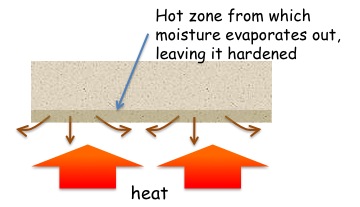
The answer lies in the manner that the chapati is heated.  Take the hottest part of the chapati—the bottom surface that is in contact with the hot pan.   Water vapor that has formed within an escape depth of this surface leaks out through the back.  This water denuded outer layer of dough now hardens, losing its malleability and making it harder for a  water vapor bubble to punch through.
 
Now the top surface needs hardening as well—which is why in the best puffed chapatis you need to heat one side, then flip over to heat the other side.  Once both surfaces have been hardened, the escape routes from top and bottom have been sealed, the growing bubble is frustrated and forced to expand laterally, as in the figure below.

Why is there a single bubble and not many?  When a bubble is formed, a new surface is created (i.e. the circumference of the bubble).  This has an energy cost because atomic bonds have to be broken to create the surface (if you split a wooden log in two, you have expended energy to break atomic bonds to create two new surfaces that weren’t there).  Systems in nature always try to minimize the energy cost if they can. If two bubbles of the same radius coalesce to form a single bubble, the surface area reduces to 2-1/3 of the original area, if n bubbles coalesce, the area reduction is a factor of n-1/3.  Creating a single large bubble instead of many small ones therefore requires a smaller area of surface to be created, and a lower energy cost.  It is thus fated that the bubbles must give up their individuality.  This is why in a good chapatti, in the end, there is one huge bubble. 

We are still left with step (iv), that the best chapattis are made when—after heating each side on a pan--the chapatti is put directly onto the flames for a vigorous fluff up.  There is a reason behind this as well. The dough is not perfect.  Some water vapor can still leak out through the top and bottom surfaces.  There is therefore a small “leak rate”.  Now when the dissolved moisture is converted to vapor in a hot chapatti, there is a certain gas generation rate. If this generation rate is much larger than the leak rate, then we can expect a good puff, otherwise not. Sticking the chapatti directly onto the flames raises its temperature and rapidly converts the moisture into gas—greatly increasing the gas generation rate and making the leak rate negligible in comparison.